Home / Work / Boomin

Boomin

Boomin

Project Overview

What this project was, and what I was responsible for.

What this project was, and what I was responsible for.

Boomin was a startup challenger entering one of the UK's most entrenched digital categories — property search. Founded by the team behind Purple Bricks, the ambition was to build a platform that genuinely served buyers rather than agents. I joined as a Product Designer working across the full platform: search, listing pages, the MatchMaker personalisation tool, and SmartVal valuation flow — all built from scratch in under a year.

Boomin was a startup challenger entering one of the UK's most entrenched digital categories — property search. Founded by the team behind Purple Bricks, the ambition was to build a platform that genuinely served buyers rather than agents. I joined as a Product Designer working across the full platform: search, listing pages, the MatchMaker personalisation tool, and SmartVal valuation flow — all built from scratch in under a year.

Role

Product Designer

Responsibilities

UX · UI · Design System · 0→1

Platform

Web (desktop & mobile)

Outcome

Search · Listing · MatchMaker · SmartVal

Introduction

Built to simplify the home-buying journey. Designed around the people most underserved by the category.

Built to simplify the home-buying journey. Designed around the people most underserved by the category.

Rightmove and Zoopla had defined what UK property search looked like for fifteen years — and both had been built around what agents wanted to list, not how buyers wanted to find. Dense grids, inconsistent tooling, and discovery treated as a filter problem rather than a human one. Boomin's challenge wasn't to copy them better. It was to design a platform that put first-time buyers at the centre.
The 0→1 nature of this project meant there were no legacy constraints — but also no existing patterns to fall back on. Every flow had to be justified from research, not convention.

Rightmove and Zoopla had defined what UK property search looked like for fifteen years — and both had been built around what agents wanted to list, not how buyers wanted to find. Dense grids, inconsistent tooling, and discovery treated as a filter problem rather than a human one. Boomin's challenge wasn't to copy them better. It was to design a platform that put first-time buyers at the centre.
The 0→1 nature of this project meant there were no legacy constraints — but also no existing patterns to fall back on. Every flow had to be justified from research, not convention.

The Problem

Property platforms built for agents, not buyers.

Property platforms built for agents, not buyers.

The category had a structural bias baked in — platforms optimised for inventory volume and listing agent satisfaction, not buyer experience. For first-time buyers specifically, this created real harm: decision fatigue from dense UIs, no guidance through a genuinely complex process, and a discovery experience that felt like a spreadsheet. The problem wasn't feature gaps. It was a fundamentally wrong mental model.

The category had a structural bias baked in — platforms optimised for inventory volume and listing agent satisfaction, not buyer experience. For first-time buyers specifically, this created real harm: decision fatigue from dense UIs, no guidance through a genuinely complex process, and a discovery experience that felt like a spreadsheet. The problem wasn't feature gaps. It was a fundamentally wrong mental model.

15 yrs

Rightmove and Zoopla had defined the category for 15 years — built for agents, not the people buying homes.

0→1

No existing platform to inherit — every pattern, flow, and component had to be built and justified from scratch.

FTB

First-time buyers were the most underserved segment — most overwhelmed, most in need of guidance, most ignored

Research & Insight

Understanding how people actually search for homes.

Understanding how people actually search for homes.

Research focused on real browsing behaviour — how people move through property platforms, where friction compounds, and what actually drives the first decision to engage with a listing. Four patterns emerged that shaped every subsequent design decision.

Research focused on real browsing behaviour — how people move through property platforms, where friction compounds, and what actually drives the first decision to engage with a listing. Four patterns emerged that shaped every subsequent design decision.

Mental model

Before

Checkout-optimised

After

Discovery-first

Platform approach

Before

Desktop-led, mobile adapted

After

Mobile-native from the start

Category experience

Before

Category as list

After

Category as editorial

Navigation

Before

Dropdown-heavy, text dense

After

Visual cards, reduced cognitive load

Product grid

Before

Fixed single layout

After

Flexible density system (3 modes)

Visual-first scanning

Users scan listings visually before engaging with any detail. Imagery drives the first decision — a poor hero photo loses the listing before copy is read.

Three decision drivers

Price, location, and photography are the primary factors early in the journey. Everything else — EPC rating, floor area, council tax band — is secondary at first glance.

Constant context-switching

Users frequently switch between list and map views to build spatial context. A platform that forces a choice between the two creates friction at a natural behaviour.

Decision fatigue

Dense UI increases fatigue and decision paralysis — especially for first-time buyers already overwhelmed by the process. Simplicity wasn't a nice-to-have. It was the brief.

The Strategy

From filter-led to discovery-led.

From filter-led to discovery-led.

The research reframed the platform model entirely. The existing category treated search as a filter problem — refine until the list is short enough to act on. Boomin's design strategy inverted that: make discovery feel exploratory, reduce the cognitive weight of each step, and meet buyers at the level of confidence they actually have rather than the level incumbents assumed.

The research reframed the platform model entirely. The existing category treated search as a filter problem — refine until the list is short enough to act on. Boomin's design strategy inverted that: make discovery feel exploratory, reduce the cognitive weight of each step, and meet buyers at the level of confidence they actually have rather than the level incumbents assumed.

AREA

BEFORE

AFTER

Discovery model

Filter until manageable

Discovery-first

Listing pages

Spreadsheet density, agent-led

Editorial layout, buyer-led hierarchy

Personalisation

Saved searches only

Guided preference capture (MatchMaker)

Valuation

Agent contact form

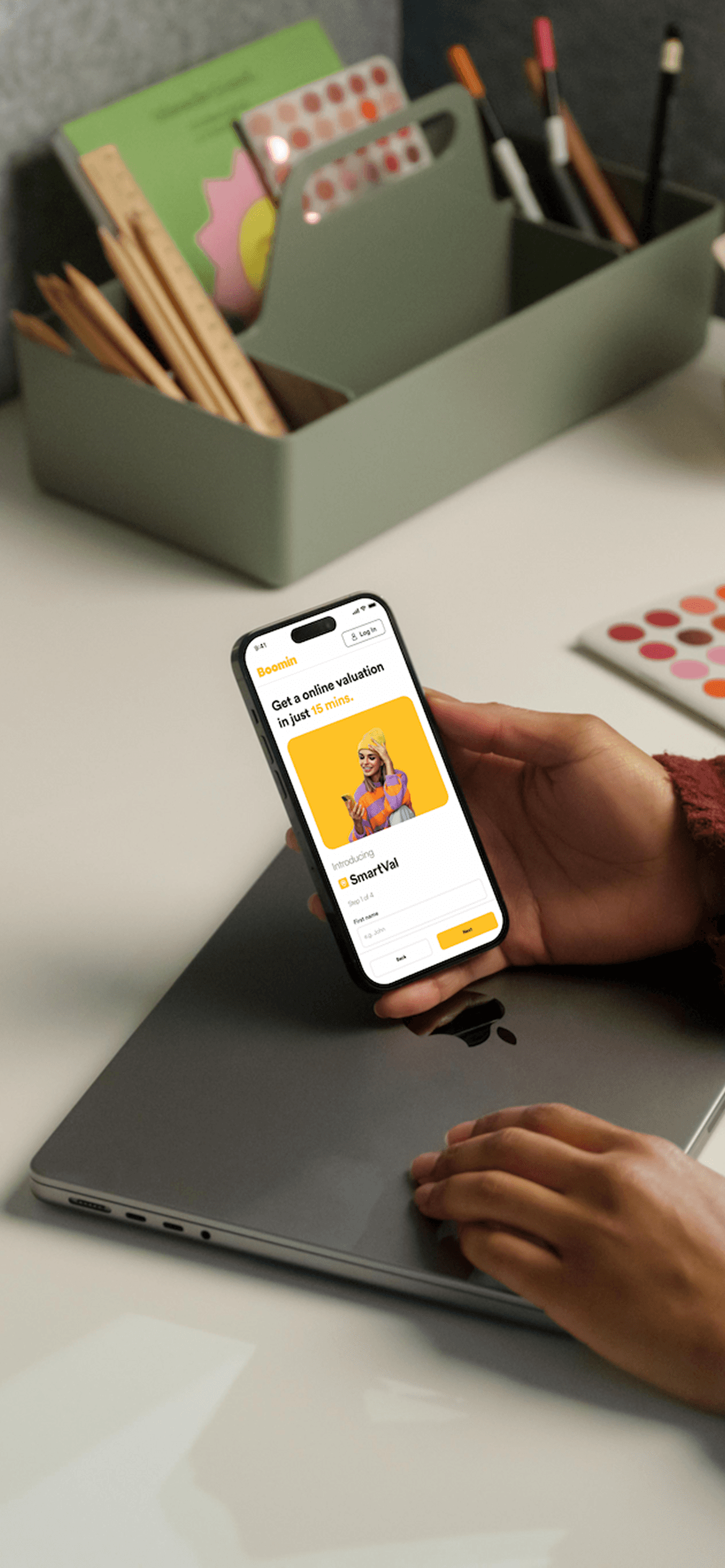
Instant self-serve estimate (SmartVal)

Map / List

Separate modes, forced choice

Unified view, switch without losing context

The Products

One platform, three flagship products.

One platform, three flagship products.

I was the Senior UI/UX Designer across Boomin's three core consumer products — Search, SmartVal, and MatchMaker. I led the craft and build of the consumer design system and designing each end-to-end flow. (Each product also had an agent-facing side, handled by a separate design team.) Together these three products defined what made Boomin distinct.

I was the Senior UI/UX Designer across Boomin's three core consumer products — Search, SmartVal, and MatchMaker. I led the craft and build of the consumer design system and designing each end-to-end flow. (Each product also had an agent-facing side, handled by a separate design team.) Together these three products defined what made Boomin distinct.

1

Search — The Core Experience

The primary experience the whole platform was built around

Purpose. 
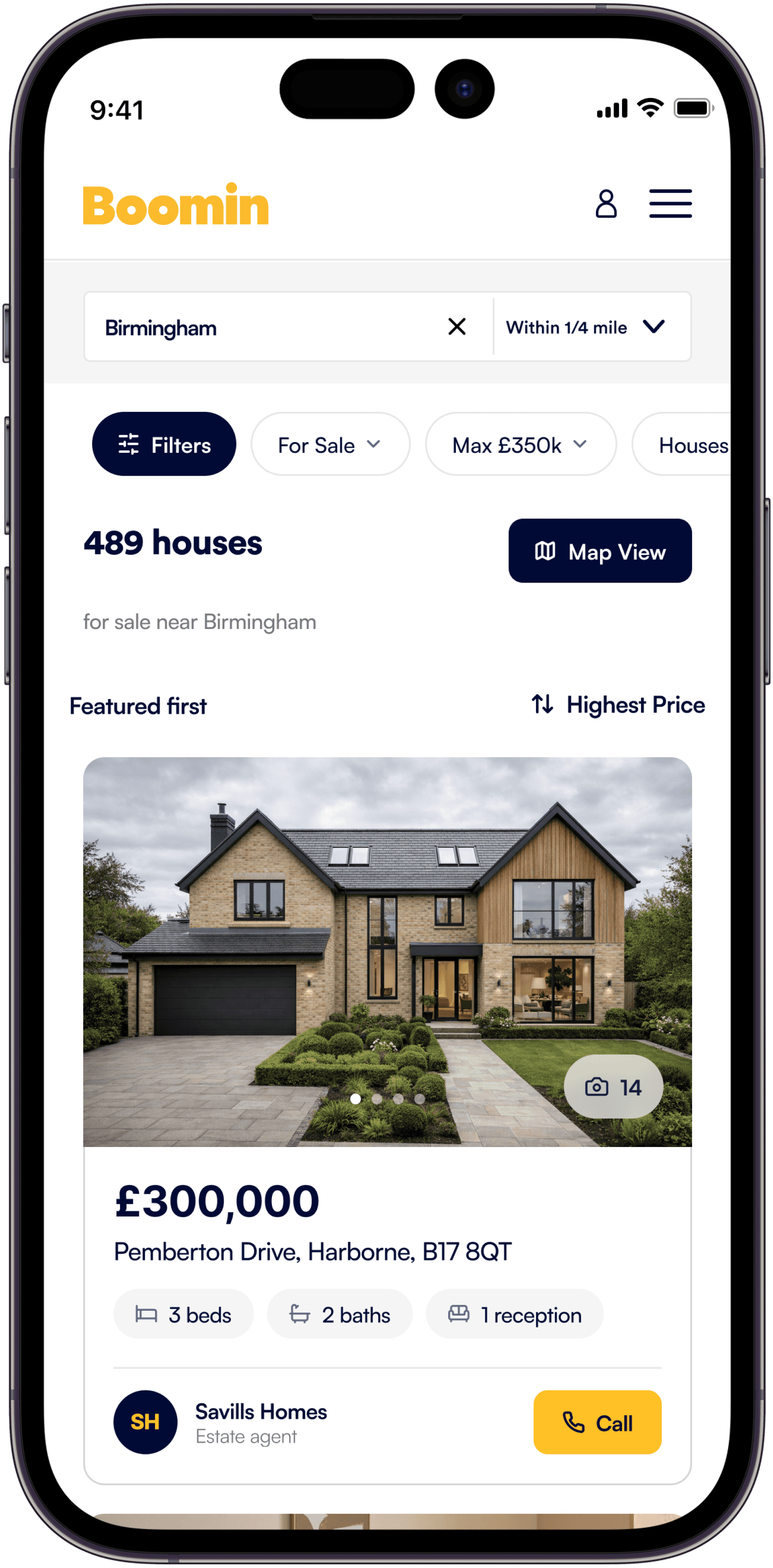
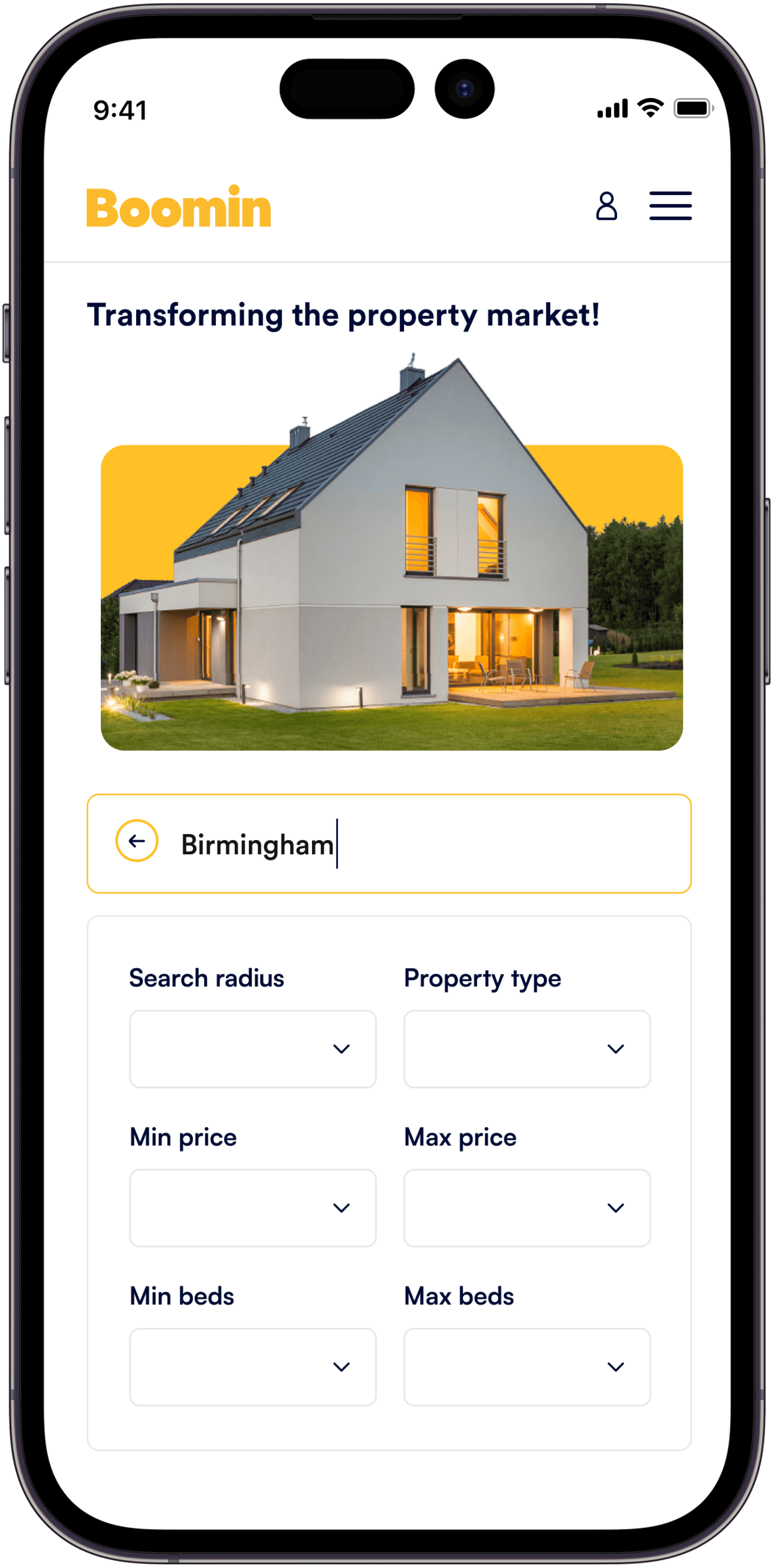
Search was the heart of Boomin. It had to feel fluid and intuitive — fast enough to find a specific address in seconds, but flexible enough to let users go as broad or as precise as they needed through filtering. Every other product fed off it.
The design challenge. 
Property search lives or dies on the balance between speed and control. Too simple and serious buyers can't refine; too complex and casual browsers bounce. The research showed users scan visually first and switch constantly between list and map to build spatial context — so the interface had to support both modes without forcing a choice.
The solution. 
An image-led results experience with a clear three-tier hierarchy — price, location, key attributes — and a unified list/map view users could move between without losing their place. Filtering was layered in progressively, invisible until needed, powerful when called on.

Purpose. 
Search was the heart of Boomin. It had to feel fluid and intuitive — fast enough to find a specific address in seconds, but flexible enough to let users go as broad or as precise as they needed through filtering. Every other product fed off it.
The design challenge. 
Property search lives or dies on the balance between speed and control. Too simple and serious buyers can't refine; too complex and casual browsers bounce. The research showed users scan visually first and switch constantly between list and map to build spatial context — so the interface had to support both modes without forcing a choice.
The solution. 
An image-led results experience with a clear three-tier hierarchy — price, location, key attributes — and a unified list/map view users could move between without losing their place. Filtering was layered in progressively, invisible until needed, powerful when called on.

2

Search — The Core Experience

A fast, credible valuation that grew the platform's supply

Purpose. 
SmartVal gave homeowners a quick, easy property valuation. The strategic aim was to attract sellers — because every seller SmartVal brought in meant more listings for agents and more inventory on the Boomin portal. It was designed as the platform's growth engine on the supply side.
The design challenge. 
A valuation is a high-trust, high-consideration moment. Ask too much and people abandon; ask too little and the estimate isn't credible. The flow had to gather enough detail to produce a real, agent-backed valuation while feeling effortless — across six steps, each a potential drop-off point.
The solution. 
A guided, progressively-disclosed flow — property type, address, features, then live local agent matching. I designed each step to carry just enough weight to feel accurate without overwhelming. When the data showed the photo-upload step was costing completions, we removed it — and average completion time and conversion both improved.

Purpose. 
SmartVal gave homeowners a quick, easy property valuation. The strategic aim was to attract sellers — because every seller SmartVal brought in meant more listings for agents and more inventory on the Boomin portal. It was designed as the platform's growth engine on the supply side.
The design challenge. 
A valuation is a high-trust, high-consideration moment. Ask too much and people abandon; ask too little and the estimate isn't credible. The flow had to gather enough detail to produce a real, agent-backed valuation while feeling effortless — across six steps, each a potential drop-off point.
The solution. 
A guided, progressively-disclosed flow — property type, address, features, then live local agent matching. I designed each step to carry just enough weight to feel accurate without overwhelming. When the data showed the photo-upload step was costing completions, we removed it — and average completion time and conversion both improved.

3

MatchMaker — Connecting Buyers & Sellers

A process the market simply didn't have

Purpose. 
MatchMaker was built around a gap we felt was missing entirely from the market — a way for potential sellers to connect with local buyers before going to market. The goal was to reduce friction in the early stages of moving and make the whole thing feel more modern and less stressful.
The design challenge. 
This was a two-sided experience with trust at its centre. Buyers needed to express exactly what they wanted; off-market sellers needed to test interest without exposing themselves. The hard part was surfacing a match compelling enough to act on while keeping both parties anonymous until they chose to engage.
The solution. 
A flow that let buyers describe precisely what they were after, and let off-market homeowners post anonymously to gauge demand. When the platform spotted a match, both sides were notified anonymously and introduced through a registered agent — never a direct contact-detail exchange. The design carried a sense of discovery and possibility rather than transaction.

Purpose. 
MatchMaker was built around a gap we felt was missing entirely from the market — a way for potential sellers to connect with local buyers before going to market. The goal was to reduce friction in the early stages of moving and make the whole thing feel more modern and less stressful.
The design challenge. 
This was a two-sided experience with trust at its centre. Buyers needed to express exactly what they wanted; off-market sellers needed to test interest without exposing themselves. The hard part was surfacing a match compelling enough to act on while keeping both parties anonymous until they chose to engage.
The solution. 
A flow that let buyers describe precisely what they were after, and let off-market homeowners post anonymously to gauge demand. When the platform spotted a match, both sides were notified anonymously and introduced through a registered agent — never a direct contact-detail exchange. The design carried a sense of discovery and possibility rather than transaction.

Design System

Three tools, one cohesive experience.

Three tools, one cohesive experience.

Rather than treating search, valuation, and discovery as separate products, the design system unified them under a single visual language and interaction model. Each tool was designed to feel like a natural extension of the browsing journey — not a separate app you'd been redirected to. The system was built in Figma with shared token foundations across colour, spacing, and type.

Rather than treating search, valuation, and discovery as separate products, the design system unified them under a single visual language and interaction model. Each tool was designed to feel like a natural extension of the browsing journey — not a separate app you'd been redirected to. The system was built in Figma with shared token foundations across colour, spacing, and type.

Unified

Single visual language across search, listing, MatchMaker, and SmartVal — consistent from first visit to valuation

Scalable

Component library built for a startup pace — flexible enough to support rapid feature iteration post-launch

Approachable

Tone calibrated for first-time buyers — bold but not intimidating, modern but not cold

The Results

From zero to national launch in under a year.

From zero to national launch in under a year.

The platform launched nationally with significant traction — 1 million users on day one, 80+ estate agents onboarded, and 100+ SmartVal valuations completed within 48 hours. These numbers validated the design approach: a buyer-first platform with lower friction could generate demand in a category that had seen no meaningful new entrant for over a decade.

1M

Users Day One

National launch to 1 million users — validating demand for a buyer-first alternative to Rightmove and Zoopla.

80+

Agents Onboarded

UK estate agents live on the platform at launch — supply-side traction secured ahead of consumer rollout.

100+

SmartVal in 48hrs

Valuations completed within 48 hours of launch — proving demand for a self-serve, agent-free valuation flow

0→1

Full Platform Built

Search, listing, MatchMaker, SmartVal — entire design system and all core flows built from scratch in 12 months

Reflection

Launch metrics aren't product-market fit.

Launch metrics aren't product-market fit.

Boomin shipped to 1 million users on day one — and still didn't survive the category. That gap between launch traction and durable demand is the lesson I carry forward most: design can win the first scroll, but the product has to earn the second visit.
The platform was well-designed for the problem we understood at launch. Where I'd do things differently is in the post-launch phase — investing earlier in longitudinal behavioural research rather than concept testing, and pushing harder on the personalisation layer that MatchMaker began but never fully delivered. Retention needed a deeper hook than discovery alone could provide.
The 0→1 experience was formative. Building an entire design system and product suite from scratch — no legacy, no inherited patterns — sharpened my instinct for what to standardise early and what to leave flexible until you have real usage data.

Boomin shipped to 1 million users on day one — and still didn't survive the category. That gap between launch traction and durable demand is the lesson I carry forward most: design can win the first scroll, but the product has to earn the second visit.
The platform was well-designed for the problem we understood at launch. Where I'd do things differently is in the post-launch phase — investing earlier in longitudinal behavioural research rather than concept testing, and pushing harder on the personalisation layer that MatchMaker began but never fully delivered. Retention needed a deeper hook than discovery alone could provide.
The 0→1 experience was formative. Building an entire design system and product suite from scratch — no legacy, no inherited patterns — sharpened my instinct for what to standardise early and what to leave flexible until you have real usage data.

Boomin ceased operations in 2022. The platform's story — strong launch, unsustainable category position — is an honest part of the case study and worth understanding in context.

Next Project

Lounge

A ground-up redesign of Lounge’s commerce experience PLP,PDP, and global navigation delivering an 8% conversion uplift as the brand transitioned from lingerie first to premium lifestyle.

View Project

JohnShawCreativeTM


JohnShawCreativeTM


JohnShawCreativeTM

Next Project

Lounge

Redesigning fashion e-commerce to drive an 80% conversion uplift, create and maintain a growing design system.

View Project